Malecon, crumbling architecture, children gathering near debris, and streets that made distance feel physical.
Food creator / Performance studies / Havana
Postcard from Cuba
A travel film and food research project asking how cuisine becomes political language when speech has to move indirectly.
Field image
A moving city note before the meal.
January Term 2026 / Havana
Food as memory, fieldwork, and political statement.
I studied abroad in Havana during January Term 2026 through a class called Postcard from Cuba. The course centered travel writing through architecture, conversation, walking, and the things we met during the day.
My interest became food: how cooking holds private memory, how recipes carry colonial history, and how a kitchen can become a social space where people say things they cannot always say directly.
I approach culinary studies as an artist-scholar committed to deep listening: through ethnographic attention, kitchen practice, and the sensory intelligence of shared meals.
Research identity
Food is where love becomes legible before it becomes spoken.
In my household, love is rarely verbalized; it is codified through the intensive labor of culinary preparation. That early exposure to food as a non-verbal language shaped the way I understand gastronomy: not only as taste, but as cultural exchange, communal belonging, and political memory.
Working beside people through chopping, tasting, translating, waiting, and learning the rhythm of care.
Daily blackouts, resource limits, conversations about leaving, and the pressure of speaking indirectly.
Salt, sugar, colonial history, Chinese memory, Cuban tradition, and the possibility of fusion cuisine.
Field breakdown
From the city to the kitchen.
Course frame
Travel writing through encounter
The class asked us to write through architecture, conversation, walking routes, and anything we encountered during the trip. The city became both text and performance space.Comparative lens
Chinese memory inside Havana
I kept connecting Cuban daily life with the culture I grew up in: censorship, family obligation, indirect speech, and food as a language that carries care when words are limited.City observation
A place suspended in time
Walking along the Malecon and through Havana, I noticed crumbling buildings, children gathering near debris, wide roads, and a city whose surface often felt paused in another decade.Resource reality
Blackouts and constraint
Daily blackouts and material limits changed the rhythm of the day. Scarcity was not abstract; it shaped meals, movement, conversation, and the emotional temperature of ordinary life.Local conversation
Translator in hand
Speaking with locals across occupations, I heard frustration with government structures and the desire many people had to leave once their visa possibilities became real.Kitchen practice
Learning beside the staff
I settled myself with people working in the kitchen: observing, helping, tasting, and learning how cooking organizes labor, intimacy, memory, and informal political expression.Research questions
What can a shared table say when public speech is constrained?
- How can food represent personal story against national media or state-shaped narratives?
- How does fusion cuisine collide with traditional cuisine, public politics, migration, and family memory?
- How do repeated everyday behaviors, like choosing what to cook, become performances that different audiences receive differently?
- How can theatre, performance, and a live meal create another kind of storytelling around culture?
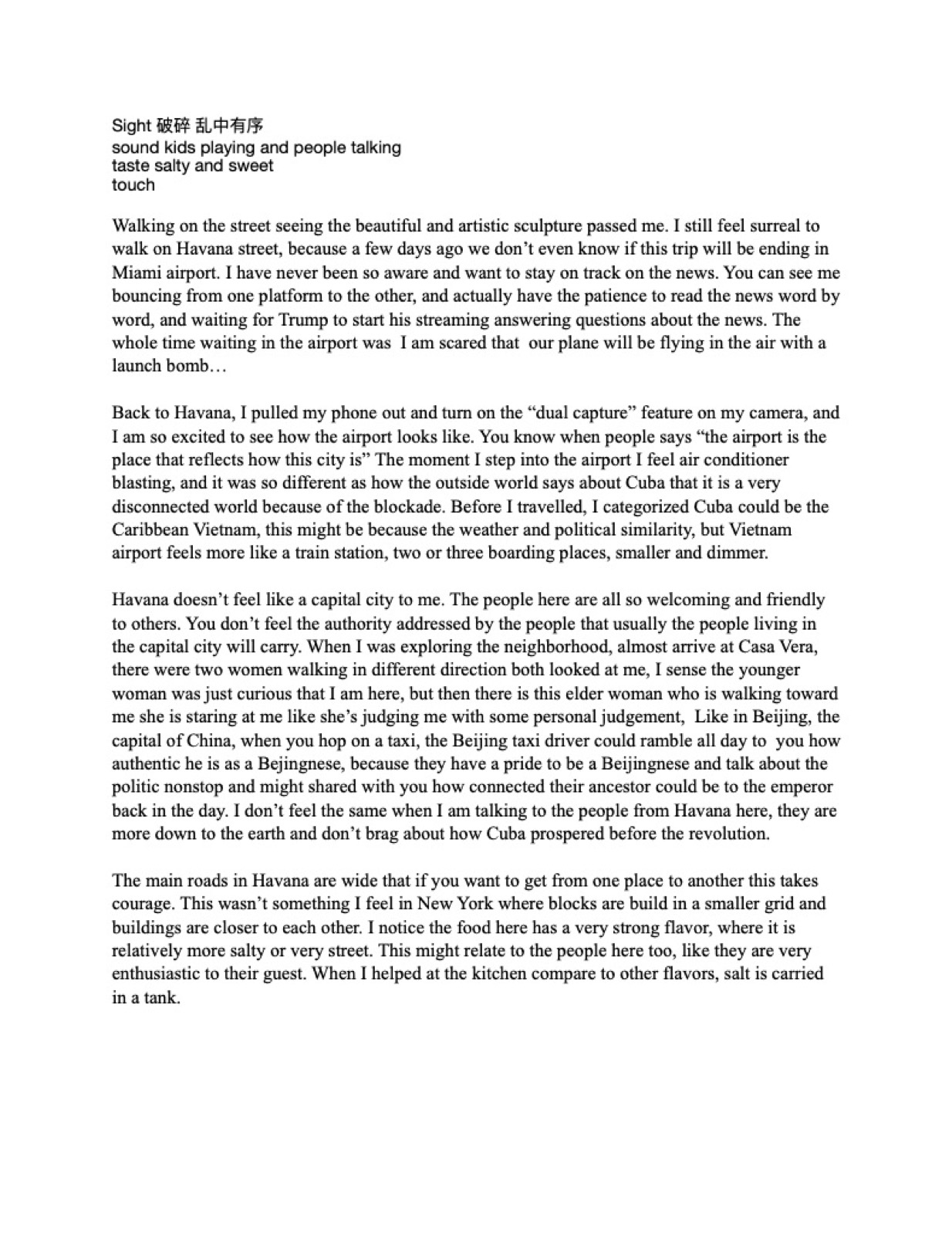
Writing journal
Observation before conclusion. Cooking before speech.
As an Asian female scholar with theatre and performance training, I am interested in how everyday behavior operates as performance. The choice to cook a certain cuisine, to serve it, to share it, and to remember through it can carry political meaning even when the cook does not announce it as politics.
My goal is to transform shared tables into forums where cultural nuance is not only discussed, but actively experienced and understood.
Watch field clip